
Choosing an industrial DTF printer starts with the work your production line needs to handle. Transfer size, daily output, printhead configuration, film width, white ink management, and powder-drying capacity all affect the final choice. A3 systems are suitable for sampling and small custom orders, while 65 cm and 1.2 m multi-head systems are better suited to recurring garment production and larger-volume work.
HJD offers DTF configurations ranging from an A3 system with two Epson XP600 printheads to 2-, 4-, 5/6-, 8-, and 12-head production systems using Epson i3200-A1 printheads. Comparing these machines by actual print width, production speed, print mode, and matching powder shaker provides a more useful basis for purchasing than printhead count alone.
What Determines the Right Industrial DTF Printer?
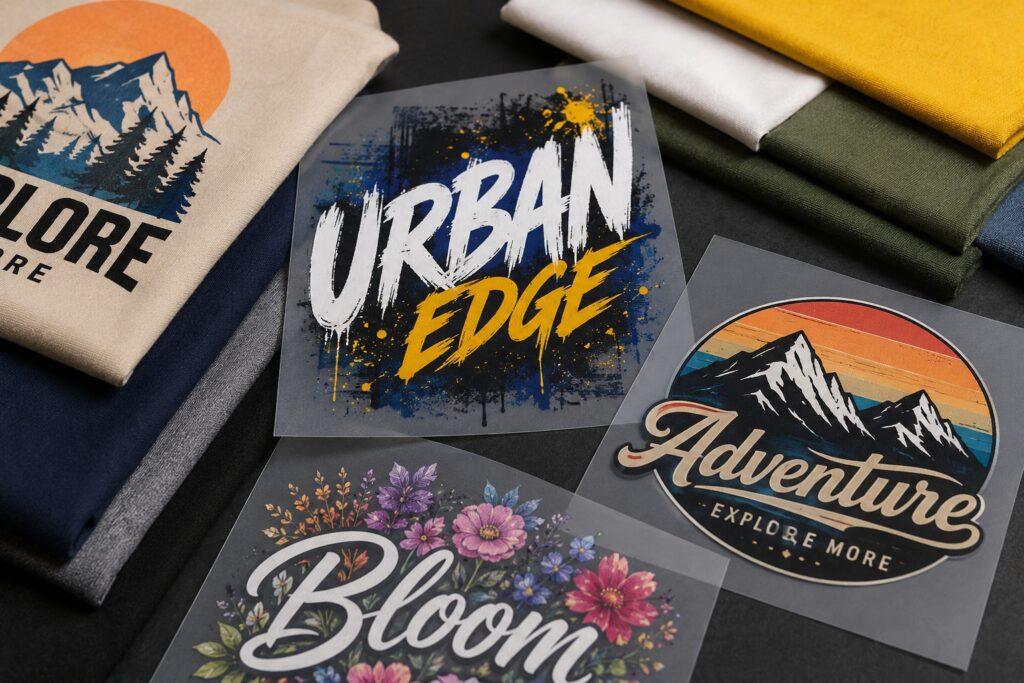
DTF production begins by printing color and white ink onto PET film. Hot-melt powder is then applied to the printed layer, followed by controlled drying before the design is transferred to the final product with heat. Printing, powder application, drying, film transport, and heat pressing therefore operate as one connected process.
Before selecting a machine, define the jobs that account for most of your production. A studio producing personalized T-shirts and samples has very different requirements from a garment factory running long batches of hoodies, workwear, sportswear, or other textile products.
Important factors include common transfer dimensions, daily film consumption, required print quality, available production space, material types, white ink usage, and expected production hours. The printer should also be paired with a powder shaker and dryer capable of handling the same film width and production rate.
How Printhead Configuration Affects DTF Production
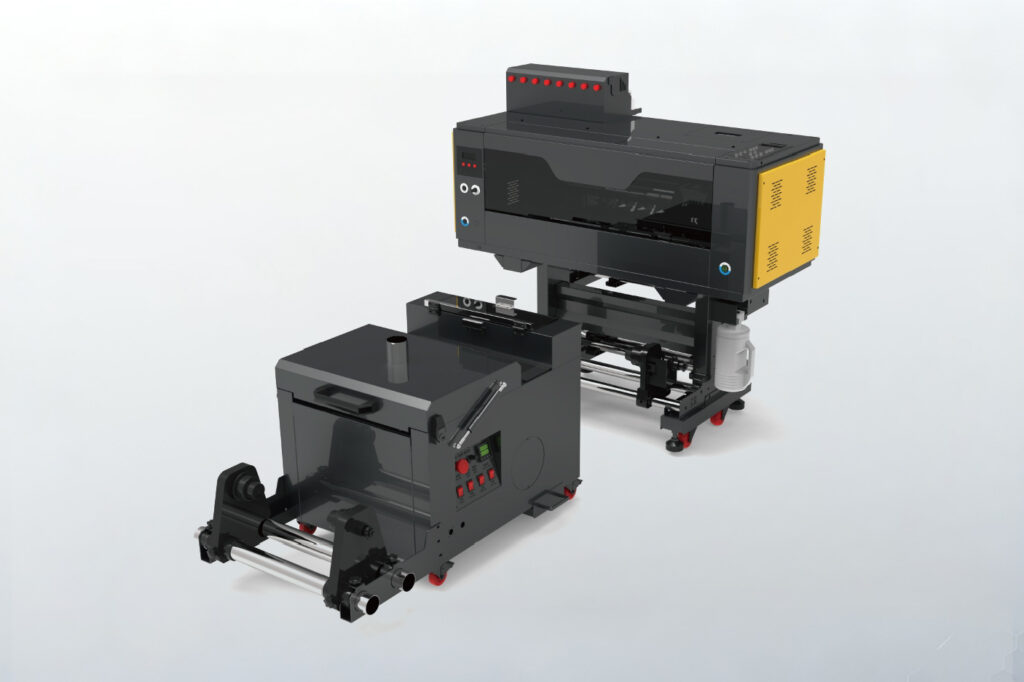
Increasing the number of printheads can raise output, but printhead count alone does not show how much usable production capacity a machine provides. Buyers should compare actual speed under the print mode they plan to use, along with print width, ink configuration, and drying capacity.
|
HJD Configuration |
Print Width |
Published Output |
Matching Drying Setup |
Typical Use |
|
A3 DTF Printer |
33 cm |
3–4 m²/h at 6 pass |
A3 powder spreader dryer, 3 lamps |
Samples and short runs |
|
2-Head DTF Printer |
65 cm |
6–8 m²/h |
Standard powder dryer, 5 lamps |
Small-to-medium recurring orders |
|
4-Head DTF Printer |
65 cm |
11–12 m²/h at 6 pass |
Extended powder shaker, 9 lamps |
Regular garment production |
|
5/6-Head DTF Printer |
65 or 120 cm |
Up to 30 m²/h in 4-color mode |
Three-temperature-zone dryer, 11 lamps |
Larger production runs |
|
8-Head DTF Printer |
Up to 120 cm |
Up to 80 m²/h in 4-color mode |
1.2 m three-temperature-zone dryer |
Wide-format, high-volume work |
|
12-Head DTF Printer |
Up to 120 cm |
Up to 100 m²/h in 4-color mode |
Three-zone dryer with dual heat sources |
Large-scale continuous production |
Actual production speed varies with color configuration, pass setting, artwork coverage, film, ink, and operating conditions. Buyers should therefore ask for output data under their intended production mode instead of comparing maximum speed figures alone.
A3 DTF Printer for Sampling and Short Runs
The HJD A3 DTF system uses two Epson XP600 printheads, supports CMYK+W pigment ink, and provides a 33 cm print width. Its documented printing speed is 3–4 m²/h at 6 passes. The system is paired with an A3 powder spreader dryer using three heating lamps.
This configuration is suitable for e-commerce sellers, creative studios, sampling departments, personalized garments, and small-batch orders. Its smaller format is useful when artwork changes frequently, and production does not require continuous wide-film output.
An A3 machine can also help businesses test new designs or produce smaller transfer jobs without committing the floor space and electrical capacity required by larger industrial systems.
65 cm Systems for Regular Apparel Orders
A 65 cm DTF printer provides more room for common garment graphics and gang-sheet layouts. It is suitable for businesses producing T-shirts, hoodies, workwear, children’s garments, sportswear, bags, and other recurring customized products.
HJD’s 2-head configuration uses two Epson i3200-A1 printheads and offers a maximum print width of 65 cm. The documented speed is 6–8 m²/h, with printing precision supporting 720 × 1800 dpi at 6 passes and 720 × 2400 dpi at 8 passes.
The 4-head configuration also supports a maximum width of 65 cm but increases production capacity. Its documented speed reaches 11–12 m²/h at 6 passes and 8–11 m²/h at 8 passes. This option is more relevant when 65 cm film meets the required transfer dimensions, but order volume has increased beyond occasional or short-run production.
5/6, 8, and 12 Heads for Higher Output
For larger order volumes, HJD offers 5/6-head configurations using Epson i3200-A1 printheads. Depending on configuration, maximum print width can be 65 cm or 120 cm, with support for 4-, 8-, and 12-color output. Published production reaches up to 30 m²/h in 4-color mode, 28 m²/h in 8-color mode, and 10 m²/h in 12-color mode.
The 8-head system expands the maximum print width to 120 cm and reaches up to 80 m²/h in 4-color mode, 37 m²/h in 8-color mode, and 13 m²/h in 12-color mode. It is intended for applications such as large apparel graphics, workwear, sportswear, shoe materials, bags, and selected home textile transfers.
For higher-volume production, HJD’s 12-head system also provides a maximum 1200 mm print width. Published output reaches up to 100 m²/h in 4-color mode, 50 m²/h in 8-color mode, and 16 m²/h in 12-color mode.
How to Choose the Right DTF Print Width
Print width should be determined by the transfer dimensions that appear regularly in production. Small logos, compact artwork, and samples may fit comfortably within an A3 workflow. When full garment graphics and multiple designs need to be nested on one roll, a 65 cm system provides more layout flexibility.
A 1.2 m DTF printer becomes more relevant when large graphics, wide gang sheets, shoe materials, home textile items, or high-volume roll production are common. Wider film allows more artwork to be positioned across the roll, but the additional width must actually be used often enough to justify the larger equipment.
Film utilization should also be considered. Efficient nesting can reduce unused film between designs, while selecting a machine much wider than normal orders may increase equipment footprint and complicate film handling without providing a meaningful production advantage.
The powder shaker must also support the selected film width. Printer width and finishing width should therefore be specified together.
Why the Powder Shaker and Dryer Must Match the Printer
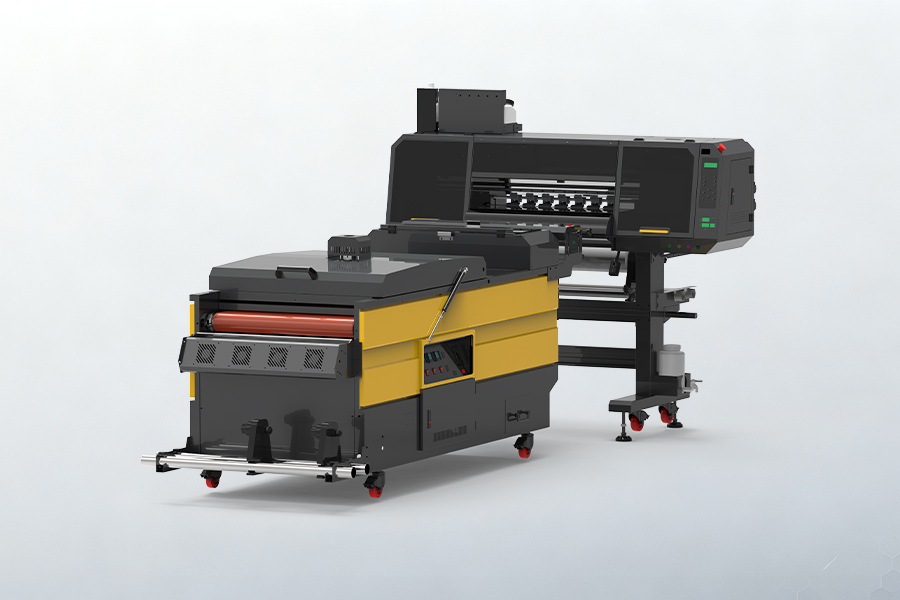
A powder shaker is part of the DTF production line rather than an independent accessory. It applies hot-melt powder to the printed film, manages excess powder, transports the film through the drying section, and prepares it for winding and subsequent heat transfer.
As printer output increases, the finishing system needs enough powder-handling and drying capacity to process the film continuously. Otherwise, a faster printer can simply move the production bottleneck to the next stage.
HJD pairs different printer configurations with different drying systems. The 2-head system uses a 4200 W powder spreading dryer with five lamps. The 4-head configuration uses an extended advanced powder shaker equipped with nine lamps and double-air supply.
The 5/6-head systems use an independent three-temperature-zone powder shaker dryer with 11 lamps. For the 8-head 1.2 m configuration, the dryer uses separate preheating, drying, and color-fixing zones. The 12-head system also uses three-zone temperature control with dual heat sources and a 13 kW drying system.
When comparing powder shakers, buyers should confirm supported film width, temperature control, heating power, powder application, film feeding, winding, electrical requirements, and cleaning access.
White Ink Management in Industrial DTF Printing
White ink creates the underbase needed to maintain opacity and color visibility, particularly when transfers are applied to dark garments. Because white pigment can settle, ink management becomes increasingly important when a DTF printer runs for long production periods.
HJD’s DTF configurations include white ink circulation and stirring functions designed to reduce sedimentation and clogging. Depending on the machine, additional maintenance functions include automatic cleaning, moisturizing, scraping, ink shortage detection, and automatic protection during abnormal operation.
These features do not eliminate routine maintenance. Operators still need to follow the recommended cleaning schedule, maintain appropriate ink conditions, and keep the machine within the specified working environment.
For many HJD DTF configurations, the documented operating environment is approximately 20–28°C with 45%–65% relative humidity. Production areas should therefore be planned with machine operating conditions in mind.
What to Confirm Before Buying an Industrial DTF Printer
A supplier can recommend a more suitable configuration when the buyer provides actual production information rather than simply requesting the fastest machine available.
Before confirming an order, provide common transfer dimensions, expected square meters per shift, garment or material types, required color configuration, normal print quality, preferred film width, available electrical supply, production space, and expected daily operating hours.
Then confirm the printhead model and quantity, speed at the required pass setting, maximum print width, RIP software, white ink circulation, film feeding, powder shaker capacity, dryer power, machine dimensions, consumable requirements, maintenance procedures, spare parts, installation, training, and after-sales support.
HJD manufactures digital textile printing equipment and related auxiliary equipment, allowing the printer and finishing system to be considered together when configuring a production line.
Conclusion
Selecting an industrial DTF printer begins with the actual transfer work being produced. Determine the required print width first, estimate output under the intended print mode, select a suitable printhead configuration, and make sure the powder shaker and dryer can process the printed film at the required rate.
White ink management, film feeding, equipment footprint, electrical requirements, maintenance, and after-sales support should also be confirmed before the final configuration is selected.
Contact HJD to compare DTF printer configurations and discuss a printer, powder shaker, and drying system for your apparel production requirements.
FAQ
Q: Is a 2-head or 4-head DTF printer better for apparel production?
A: The choice depends mainly on production volume. HJD’s 2-head and 4-head configurations both support a maximum width of 65 cm, but the 4-head version provides higher production capacity and is paired with a larger powder shaker. Compare expected daily film output, print mode, available space, and finishing capacity before selecting either configuration.
Q: How should I match a DTF printer with a powder shaker?
A: Start with film width and actual printer output. The powder shaker should also provide sufficient heating capacity, temperature control, powder application, film transport, and winding performance for continuous operation. Higher-output HJD systems use extended or multi-temperature-zone dryers so that powder application and drying capacity can keep pace with the printer.
Q: What print width should I choose for T-shirt DTF printing?
A: Choose according to the artwork dimensions and gang-sheet layouts used most frequently. A3 equipment is suitable for smaller designs and samples, while 65 cm printers provide more layout space for regular garment production. A 1.2 m system is more appropriate when wide graphics, larger gang sheets, or higher-volume production regularly use the additional width.
Q: What specifications should I confirm before buying a DTF printer?
A: Confirm the printhead model and quantity, maximum print width, speed at the required pass setting, ink configuration, white ink circulation, RIP software, film feeding system, powder shaker and dryer capacity, electrical requirements, operating environment, consumable usage, machine dimensions, maintenance requirements, spare parts, installation, training, and after-sales support.